How to read music: notes, staff and rhythm for beginners
How to read music
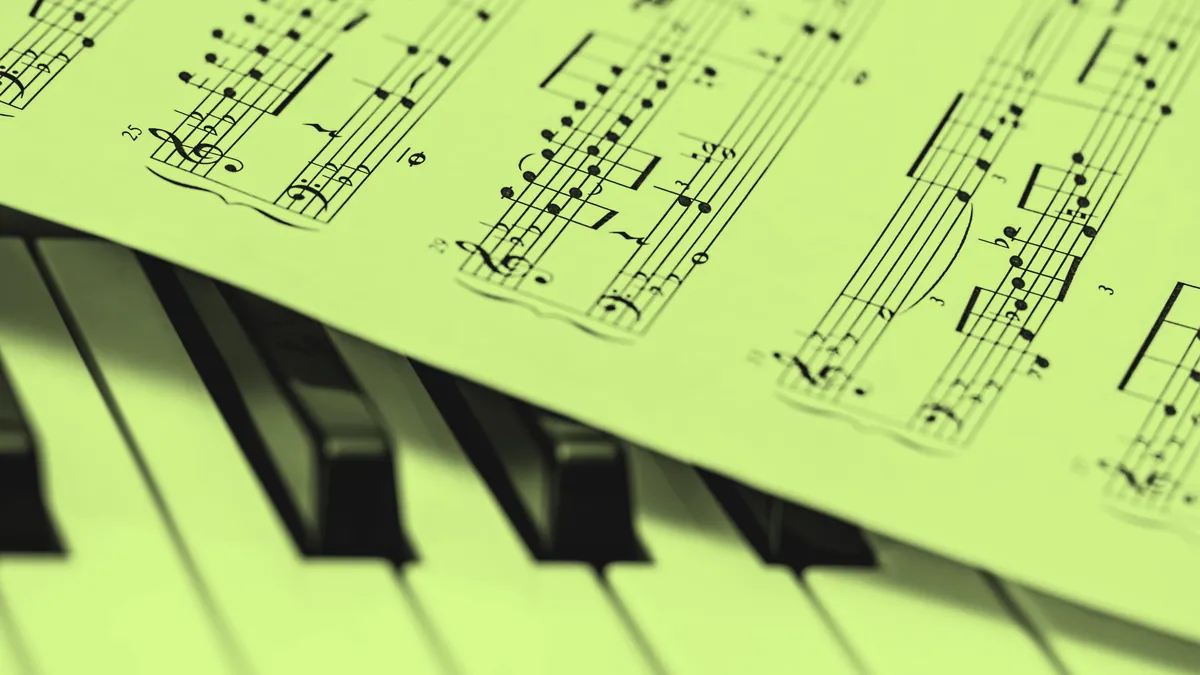
Reading music means looking at symbols on a five-line staff and knowing, without playing a note, which pitch each symbol represents and how long it lasts, that's the whole system, and once you can decode both pieces, any page of sheet music turns into actual sound in your head.
It's a notation system, not a performance skill; you can learn to read it the same way you'd learn to read a map, without ever driving the route.
Most searches for this topic assume reading music requires an instrument in your hands, a guitar, ukulele, or piano, and thirty days of drills from a beginner book. You can learn the core system faster than that, and purely as a listener, because the notation itself is just a code for pitch and rhythm. Once you know the code, you can look at a lead sheet or follow along with a score and understand what's happening in a recording, even if you never press a key or fret a string.
What the staff and clefs actually show you
Music is written on a staff: five horizontal lines and the four spaces between them, each one representing a specific pitch. Because a staff of five lines can only cover so much range, a clef symbol at the start tells you which set of pitches you're looking at.
- Treble clef (the curling symbol also called the G clef) is used for higher-pitched instruments and voices, right hand on piano, guitar, violin, most vocal melodies. Its five lines, bottom to top, are E-G-B-D-F, commonly remembered as "Every Good Boy Does Fine." The four spaces spell F-A-C-E.
- Bass clef (the F clef, with two dots) covers lower pitches, left hand on piano, bass guitar, cello, low male voices. Its lines are G-B-D-F-A ("Good Boys Do Fine Always") and its spaces are A-C-E-G ("All Cows Eat Grass").
Piano music is usually written on both staves at once, stacked together as a "grand staff," because piano covers both ranges simultaneously. Guitar and ukulele music is typically written in treble clef alone, since both instruments sit in a higher range, but guitar music is very often shown as tablature or chord diagrams instead of standard notation, because the same pitch can be played in several different spots on the neck, which staff notation doesn't show.
How note names work once you're off the staff
There are only seven note letter names, A, B, C, D, E, F, G, and after G, the sequence just starts over one octave higher. Where a note sits on the staff (which line or space) tells you its letter name; ledger lines (small extra lines added above or below the staff) extend the range further, which is how notation reaches very high or very low pitches without needing a wider staff. Sharps (♯) raise a note by a half step and flats (♭) lower it by a half step, the black keys on a piano are the sharps and flats sitting between the white-key natural notes.
Note values: how notation shows rhythm
Pitch tells you which note to play; note values tell you how long to hold it. The shape of a note, whether its head is filled in, whether it has a stem, and how many flags hang off that stem, sets its duration relative to a steady beat.
| Note | Common name | Beats in 4/4 time |
|---|---|---|
| Whole note | semibreve | 4 beats |
| Half note | minim | 2 beats |
| Quarter note | crotchet | 1 beat |
| Eighth note | quaver | 1/2 beat |
| Sixteenth note | semiquaver | 1/4 beat |
A dot placed after any note adds half its value again, a dotted half note becomes 3 beats instead of 2. Rests use the same duration system to notate silence: a specific symbol for a whole rest, a half rest, a quarter rest, and so on, each lasting exactly as long as its matching note would. Reading rhythm is really just reading a kind of subdivided grid, and once you can count "1-2-3-4" against a measure and see which beats have notes versus rests, the rest of rhythm notation is pattern recognition.
Key signatures: the shortcut sheet music uses
Rather than writing a sharp or flat symbol next to every single note that needs one, notation groups them into a key signature, a cluster of sharps or flats placed right after the clef, at the start of every line, that applies for the whole piece. A piece with no sharps or flats in its key signature is most likely in C major or its relative minor, A minor. Sharps are always added in a fixed order (F, C, G, D, A, E, B), and flats in the exact reverse order (B, E, A, D, G, C, F), so seeing one sharp tells you it's F♯, and that the key is almost certainly G major. This is what lets a trained reader glance at the start of a piece and immediately know which notes will sound "off" if played natural.
Chord symbols and lead sheets versus full notation
Not everything you'll encounter is fully notated. A huge amount of popular sheet music, especially for guitar, ukulele, and piano-vocal arrangements, uses a "lead sheet" format: the melody written in standard notation on the staff, with chord symbols (like C, Am, G7) printed above it instead of every harmony note being spelled out. Guitarists and ukulele players usually pair that with chord diagrams, small grids showing exactly where to place fingers for each chord shape. Reading a lead sheet is a hybrid skill, you read the melody the normal way and read the chord symbols as shorthand for a whole cluster of notes played together, which is faster to learn than reading every harmony note individually and is how most gigging musicians actually read.
A realistic path from zero to reading confidently
You don't need a semester-long course or a dense theory book to get functional at this. A practical order looks like:
- Learn the seven letter names and where they sit in treble clef, using the line and space mnemonics.
- Learn the five common note values and how they relate to a steady beat, clap or tap along with a metronome while counting.
- Learn what a key signature is and how to read the first one or two sharps or flats.
- Practice on real, simple examples, beginner-level printable worksheets and short public-domain melodies, rather than jumping straight to a full song.
- If you play or sing, apply it: sight-read very short, slow phrases before attempting anything fast.
Done in short daily sessions, the core reading skill, pitch plus rhythm, is realistically a two-to-three-week project, not the "30 days to mastery" framing some beginner guides use. Fluent sight-reading at speed, the way an orchestral musician does it, takes years; recognizing what's on the page well enough to understand a piece of music does not.