What is rock music? Where it came from and how it splits
What rock music is
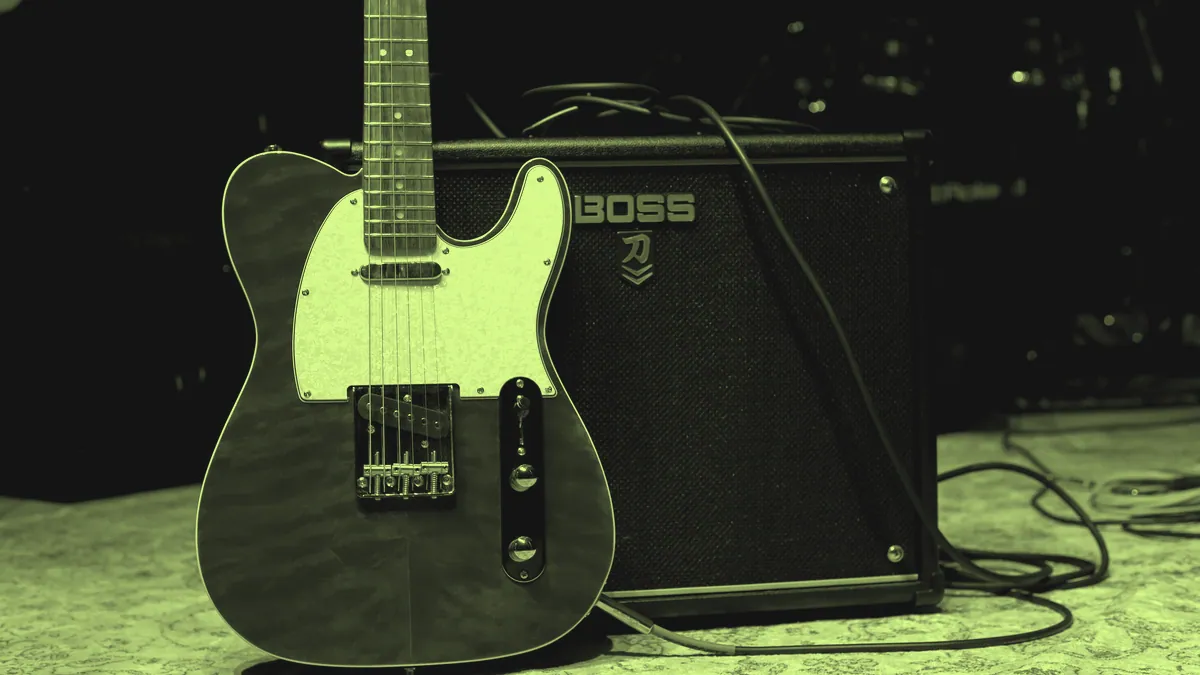
Rock music is a genre built around electric guitar, bass, and drums as its core instrumentation, played with a driving backbeat, that emerged in the 1950s out of blues and country and has since splintered into dozens of subgenres.
It started as rock and roll, dance music built on blues chord structures played faster and louder, and over seven decades that core setup got stretched, distorted, slowed down, sped up, and reimagined in enough different directions that "rock" now covers everything from a three-chord punk song to a sprawling progressive-rock suite.
The instrumental core that defines it
What holds "rock" together as a category, even across wildly different sounds, is the instrumentation: electric guitar (often with some distortion or overdrive), electric or acoustic bass, and a drum kit, usually built around a steady, accented backbeat, the emphasis landing on beats two and four, the same pulse that made blues and R&B danceable. Vocals sit over that foundation, but the guitar is usually the lead voice of the genre, whether it's playing a riff, a solo, or just driving rhythm. That's different from pop, where the vocal hook and production are the focus, or from electronic music, where the rhythm often comes from programmed beats and synthesizers rather than a live drummer. Rock bands can and do add keyboards, horns, or strings, but the electric-guitar-bass-drums trio is the genre's default shape, the setup you'd assume a "rock band" has before hearing a single note.
Where it came from
Rock's direct ancestors are blues and country. Blues supplied the chord structure, the same three-chord, 12-bar framework that shaped Delta and Chicago blues, plus the guitar phrasing and the bent, expressive "blue" notes. Country contributed melodic songwriting, storytelling lyrics, and in some strands, the twangy guitar tone. Chuck Berry fused those elements explicitly in the mid-1950s, speeding up blues guitar licks into something new; Elvis Presley combined blues, gospel, and country in his early Sun Records sessions in a way that became the template for the sound. By the early 1960s, British bands like the Rolling Stones and the Beatles were absorbing American blues and rock and roll records and sending a reworked version back across the Atlantic, which is part of why rock's history runs through both American and British scenes almost from the start.
How it splits into subgenres
Once rock became a mainstream genre, it fragmented quickly, with each branch emphasizing a different piece of the original formula, more distortion, more volume, more complexity, more simplicity, or a fusion with another genre entirely.
| Subgenre | What it emphasizes |
|---|---|
| Classic rock | 1960s, 70s guitar-driven rock, the genre's mainstream baseline |
| Punk | Speed, simplicity, and raw energy over technical polish |
| Progressive rock | Long compositions, complex time signatures, classical influence |
| Metal | Heavy distortion, volume, and technical guitar and drum playing |
| Alternative / indie rock | Guitar-based rock outside the mainstream commercial mold |
| Funk rock / rock-fusion | Rock combined with funk rhythm, jazz harmony, or electronic texture |
These branches also constantly borrow from neighboring genres. Southern rock leaned on country. Rock steadily absorbed funk's rhythmic groove in bands built around a tight, syncopated bass line. Later, some rock acts folded in ambient textures and electronic production, blurring the line between a rock band and an electronic act. None of these branches replaced the others, they coexist, which is why "rock" today can mean a stadium arena act and a lo-fi bedroom guitar recording at the same time.
How rock relates to the genres around it
Rock sits in direct conversation with blues, country, soul, and folk. Soul and gospel's vocal intensity shaped rock singers from Janis Joplin to countless later frontpeople who lean on that same raw, emotional delivery. Folk's acoustic instrumentation and lyrical storytelling fed directly into folk rock in the 1960s, when artists like Bob Dylan plugged in an electric band. Jazz's harmonic complexity shows up in progressive and fusion-leaning rock. And rock has repaid these genres too, country music absorbed rock's electric instrumentation and stadium-sized production decades ago, which is part of why modern country and rock can sound closer to each other than either does to its 1950s roots.
Musicians and records that shaped the genre
A short list of records and artists gives a useful map of where rock has been: Chuck Berry's early singles for the genre's blues-to-rock blueprint; the Beatles' Abbey Road and the Rolling Stones' Exile on Main St. for the British Invasion's return volley; Led Zeppelin IV for the blues-into-hard-rock template that shaped metal; the Ramones' debut for punk's stripped-down reset; Nirvana's Nevermind for the alternative-rock explosion of the early 1990s; and Radiohead's OK Computer for rock stretching toward electronic and experimental territory. Working through records like these in rough chronological order shows the genre evolving in real time rather than treating "rock" as one static sound, because by the time you reach a modern rock act, you're really hearing the accumulated influence of blues, country, punk, and everything rock absorbed along the way.